

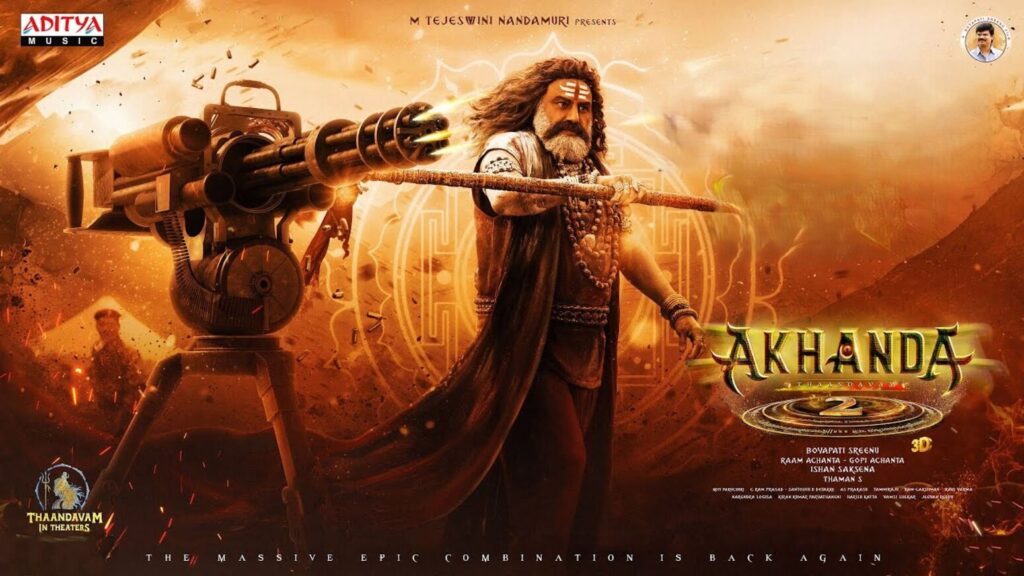
Akhanda 2 is one of those films where you can clearly see the emotion, belief, and conviction behind it but you can also see how badly it needed control. This is not a lazy film. This is not a film made for mockery. But it is a film that mistakes volume for impact and belief for storytelling.
Compared to this, the first Akhanda (2021) genuinely feels more grounded and effective, even though it was over-the-top too. That film at least knew when to stop. This one doesn’t.
The Review
On paper, Akhanda 2 actually chooses a stronger and more dangerous subject than the first part. Instead of environmental destruction, the sequel talks about something far more sensitive , the destruction of faith. The idea that if you want to break a civilisation like India, you don’t attack it with weapons first, you attack what people believe in.
The Mahakumbh becomes the centre of the conflict. A large-scale conspiracy involving foreign powers, a political leader, and a tantric using dark practices aims to poison people not just physically, but spiritually so that belief itself collapses.
This idea is not stupid.
This idea is not cheap.
This idea is actually powerful.
The problem is how it’s told.
Boyapati Srinu directs this film with absolute sincerity and that’s both its strength and its biggest weakness. You never feel that he is mocking faith or using religion cynically. He believes every word he puts on screen. But belief alone does not create good cinema. There is no breathing space. No silence. No pause for thought. Characters don’t talk and they announce. Dialogues don’t flow they attack you. Every scene is designed to feel like a climax, and when everything is a climax, nothing feels special.
Important philosophical questions are raised:
- Does God intervene?
- Is faith transactional?
- Are humans responsible for their own downfall?
But instead of exploring them, the film rushes past them to deliver another slow-motion shot or loud background score cue.
The Performances
Nandamuri Balakrishna is fully committed, and that much is undeniable. At 65, his energy is not the problem. His presence is not the problem. The problem is that the character is written as invincible from start to finish. There is no real challenge, no worthy opposition, no moment where you feel he might fail. The villains, despite grand introductions, feel like caricatures. The tantric in particular is built up with supernatural promise, but when it finally comes to confrontation, the payoff is flat and disappointing. Supporting characters exist mostly to react, praise, or get lectured.
Action & Visuals
Over-the-top action is expected in a Balakrishna film. That’s not the issue.
The issue is that the action here often slips from massy into unintentionally funny. Physics is abandoned, logic is optional, and digital effects look strangely cheaper than the first film. Some sequences feel more like visual noise than spectacle. Instead of awe, you feel distance. Instead of intensity, you feel fatigue. Divine imagery needs atmosphere. Here, it gets buried under poor VFX and excessive sound design. The background score tries very hard to recreate the impact of the first film but rarely succeeds. While chants and mantras add weight in theory, the constant loudness becomes exhausting.
Silence would have helped this film more than another music cue.
Final Verdict and Rating
Akhanda 2 is not a film you hate. It’s a film you wish was better.
You can see the heart behind it. You can feel what it wants to say. But cinema is not just about intention it’s about execution, rhythm, and trust in the audience.
Faith is powerful.
Belief is powerful.
But storytelling still needs discipline.
Rating: 1/5
This film will strongly appeal to hardcore fans and believers in the Akhanda aura. For everyone else, it may feel loud, tiring, and unintentionally amusing even when it wants to be serious.
